Validate Model
This section outlines the required inputs and step-by-step procedure for running a backcast and calibrating the Reserve Calibration Factor in iPool Suite.
- Required Inputs
- Step-by-step procedure
- Exercise
Backcasting and Calibration
Backcasting involves modeling historical load data to improve the accuracy of future forecasts. This section outlines the components required to successfully run a backcast and its calibration.
Before proceeding, ensure that the historical load has been completed. The only remaining Historical Database Errors should be Out-of-Merit No Bid, Out-of-Merit Outage, and/or Line Outage.
Prerequisites
- Historical Demand —
Dem_XXX.csv— automatically generated when the historical load is run. Saved in the Demands folder directory. The filename corresponds to the scenario name used in the historical load. - Historical Generation —
Gen_XXX.csv— also generated by the Historical Load. Saved in the Generations folder directory. - Historical Bids —
OM_XXX.bid— the automatically generated bids for out-of-merit units with missing bids. For simulations using a historical time frame, auto-bid loading can be used with the parameters-abf ALLand-ab 1. - Historical Events —
Ev_XXX.csv— the list of automatically captured events (particularly outages) from the Historical Load. Generated in the Events folder of the working directory.
Backcast and calibration can also be performed at a 1-hour interval, with minor changes to the
demand and generation files. The required files should have filenames in the format
DemHR_XXX.csv and GenHr_XXX.csv.
Step-by-Step Guide
- Phase 1: Create a Backcast
- Phase 2: Calibrate Reserve Factor
Create a Backcast Using Scenario Studio
- Open iPool Suite, then go to Scenario Studio and click + Add command.
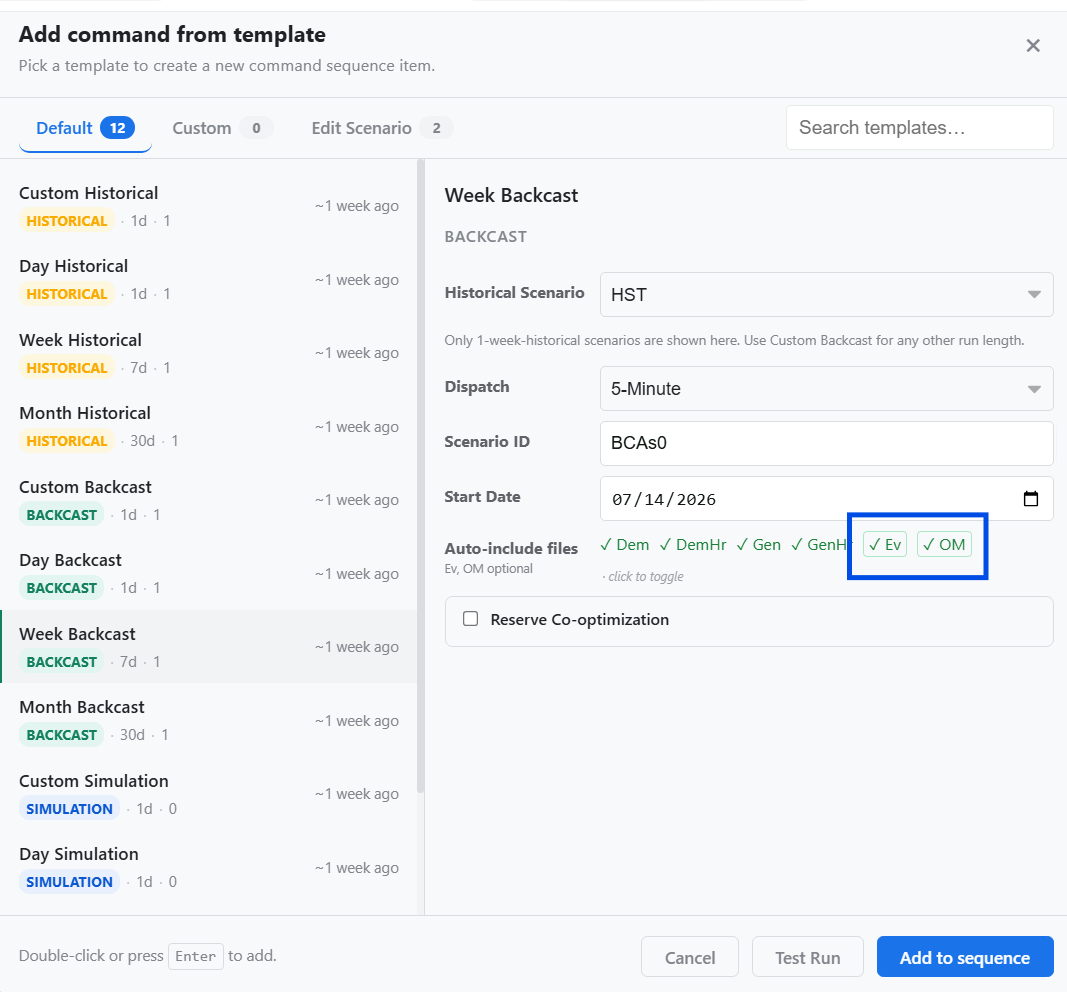
- Select an appropriate backcast template. In the template picker, fill in:
- Historical Scenario — select the source historical scenario from the dropdown.
- Scenario ID — a name for this backcast run.
- Start Date — auto-filled from the selected historical scenario; adjustable.
- By default, the captured events and the generated bids for out-of-merit no-bid units are included. These can be excluded by clicking or deselecting the corresponding options.
- After completing the setup, click Add to sequence. This setup creates a backcast using a spin parameter of 0.
Calibrate the Reserve Calibration Factor
To further calibrate the model, adjust the Reserve Calibration Factor (-pcsr) to
increase or decrease the simulation's reserve requirement.
- Increasing the
-pcsrvalue tightens the system by requiring more reserve, which generally leads to higher energy prices. - Decreasing the
-pcsrvalue eases the reserve burden and leads to lower energy prices.
This factor is a practical tool to account for unmodeled real-world complexities, such as private contracts or market uncertainties.
To calibrate:
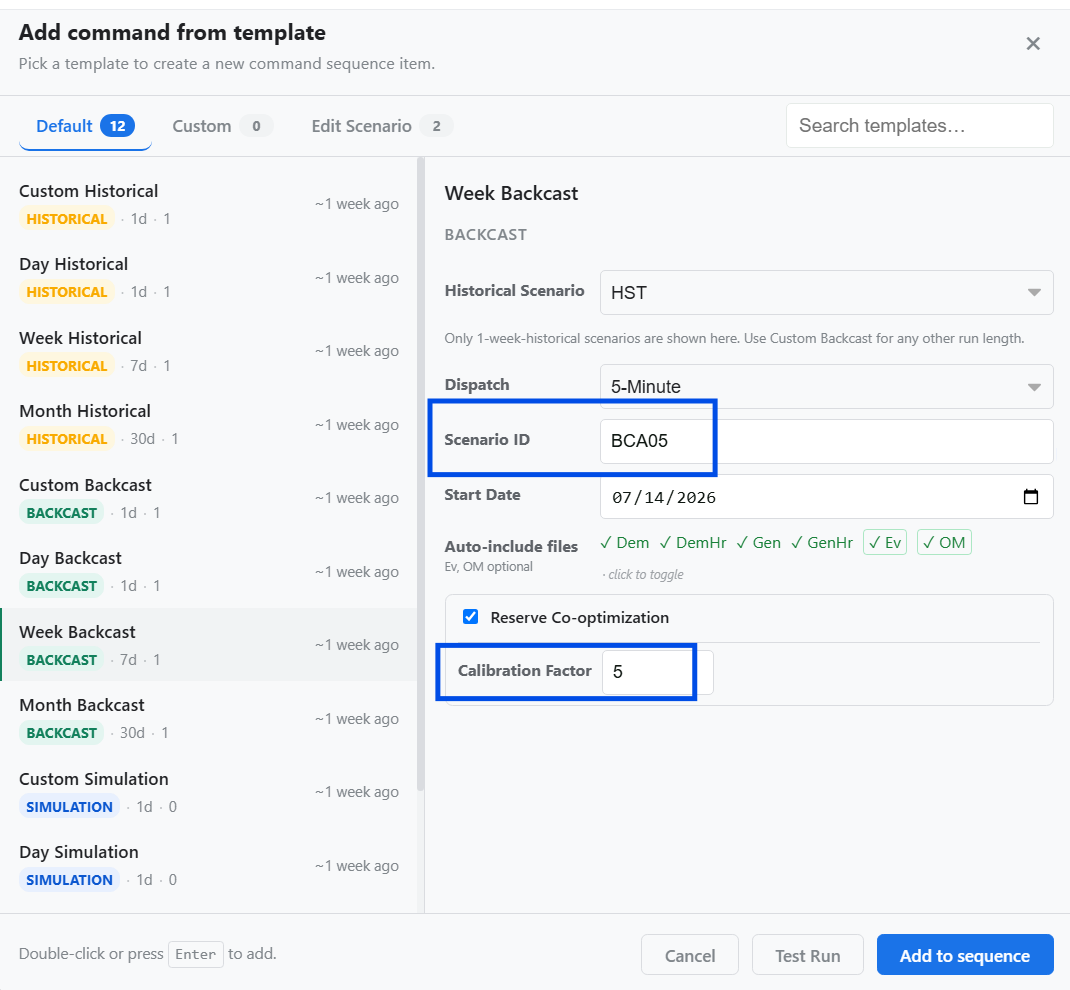
- Repeat Step 1, but use a different Scenario ID.
- Enable Reserve Co-optimization. This sets the spin parameter to 1.
- Choose Calibration Factor from the reserve options, then enter a value in the Reserve Factor (-pcsr) field.
Alternatively, select LP Co-optimization to use co-optimisation (-coopt) instead
of the calibration factor approach. -coopt automatically enables spinning reserves
(-spin 1) unless -spin 0 is passed explicitly.
-
After completing the setup, click Add to sequence.
When Reserve Co-optimization is enabled, two additional scale fields are shown:
- Reserve Bid Quantity Scale (-pcrq) — scales the reserve bid quantity (percent; 100 = no change; ladder clearing only).
- Reserve Bid Price Scale (-pcrp) — scales the reserve bid price (percent; 100 = no change; ladder clearing only).
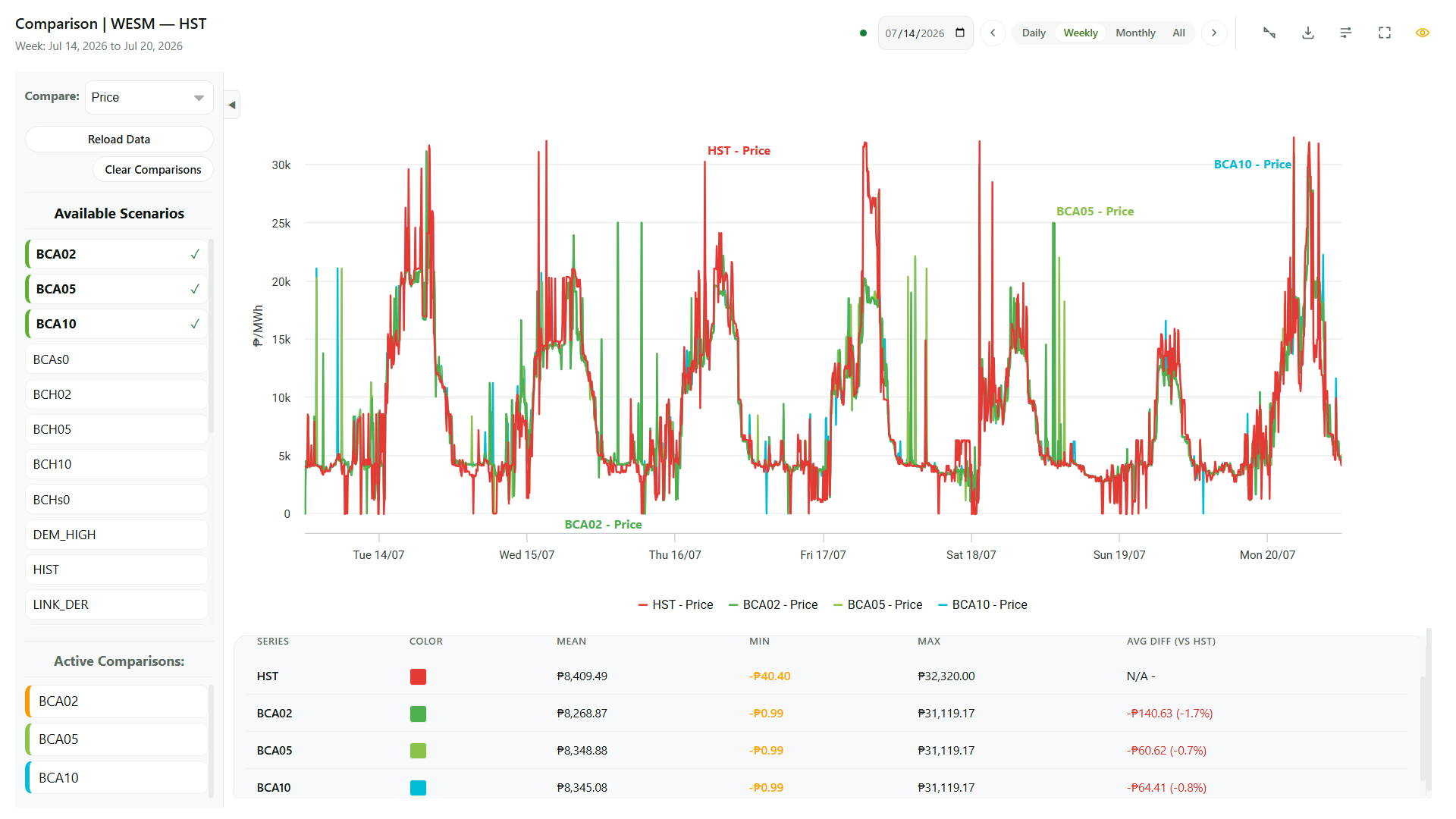
Tip: Create multiple backcasts with different reserve calibration factors, then compare the results using the Comparison View capability of Dashboard.
Adjust the -pcsr value using trial and error, comparing simulated results with historical
values until they align. Once the backcast is calibrated, apply this same -pcsr value to
forecasts and what-if scenarios.
If multiple scenarios are present, the top-most scenario in the sequence list will be executed first.
Exercise
Give it a try and do this exercise:
Step 1 of 3
Verify Prerequisites